2025 Q4 Health Review
Reflection
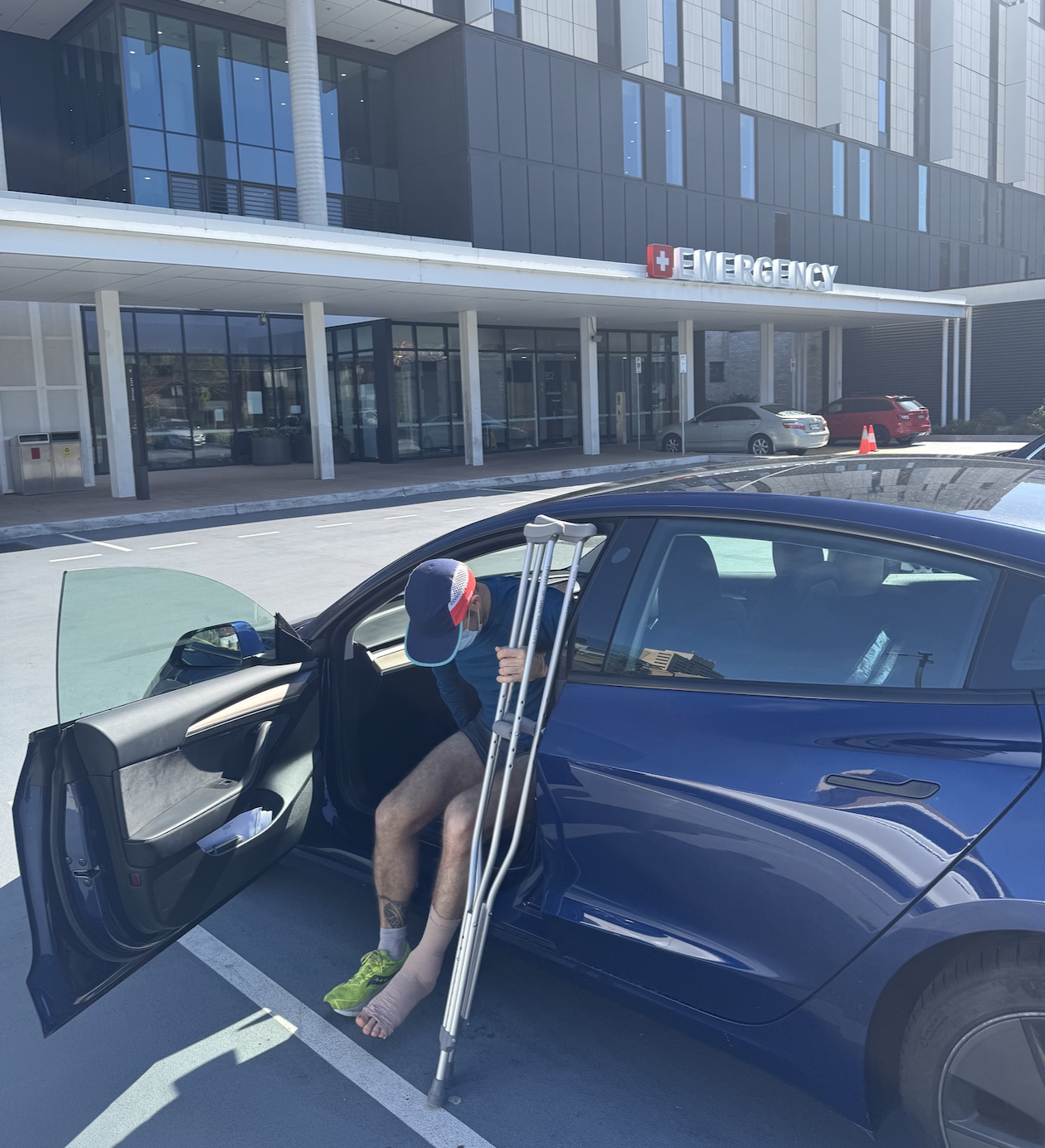
2025 wrapped up with another hard quarter, unfortunately. Coming off some travel in September there were some events at work in October and November that were especially challenging, and in late November I got a little sick. Even worse is in early December I managed to break my ankle at the local Parkrun. This was well timed for a long road trip towards the end of December, which suited me well given my condition, but did mean exercise slowed down.
However, I treated this quarter as a test: perhaps there wasn’t an improvement, but I’ll still regularly try to make better decision instead of worse decisions.
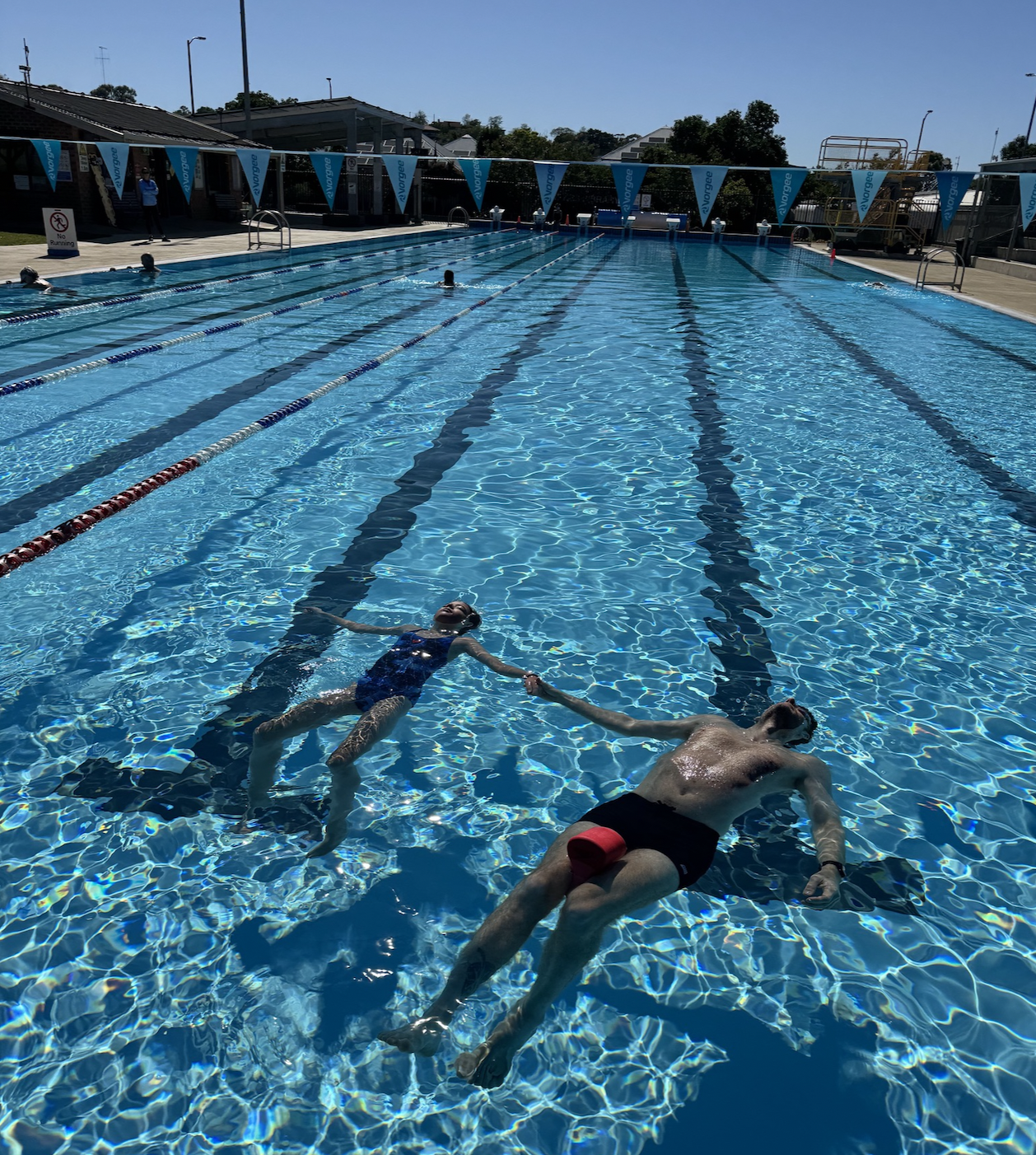
One part of the test is flipping what could be so many negative thoughts into positive experiences. For example, with my ankle, I used this as an excuse to dedicate more time to learning how to swim.
Focus Areas
As usual, there are four areas that I wanted to focus on:
- Improve fitness by training more. My goal is to maintain 800 intensity minutes on average per week.
- Sleep better by improving my sleep hygiene and experimenting with meal timing.
- Reduce stress by examining meal composition and avoiding anything that might impact my sleep
- Improve biomarkers by looking at my nutrition, as well as the above items.
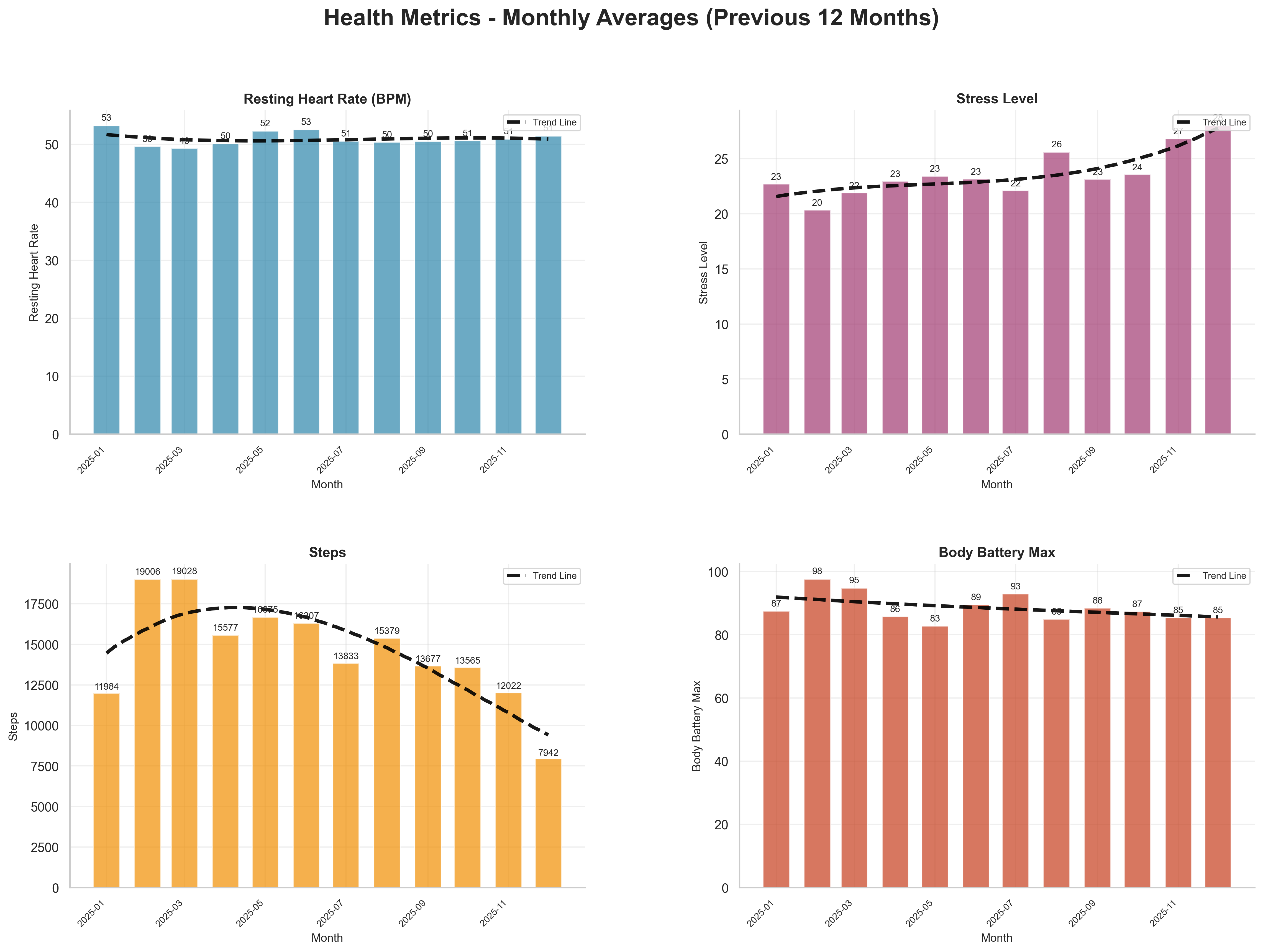
Overall most metrics saw a decrease in Q4, as we can see with the following key metrics.
We can see correlations for the quarter with the below correlation matrix.
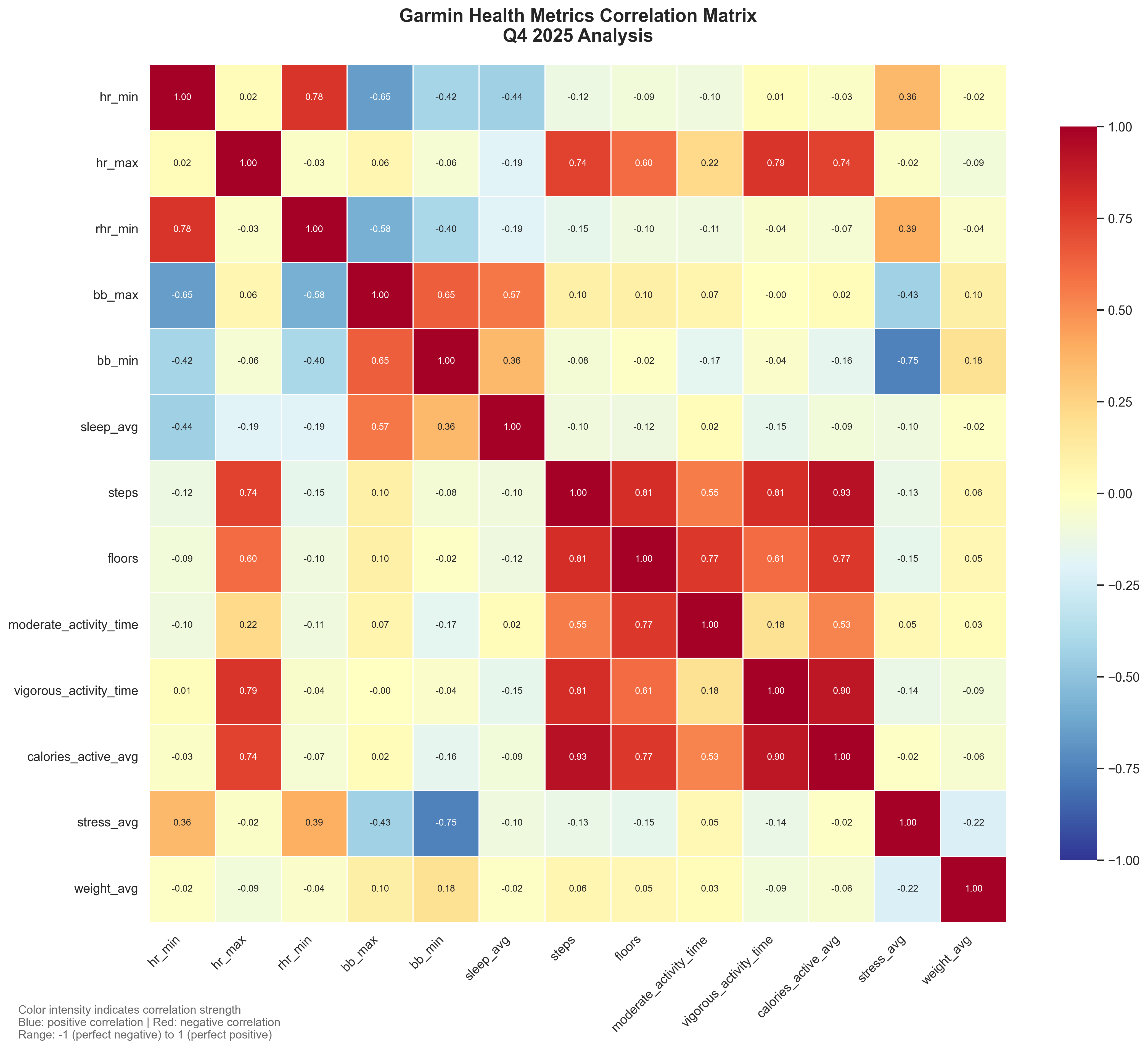
Looking at the correlations, a few stood out:
- My sleep_avg correlates negatively with hr_min (or rhr_min). Interestingly, for the year it correlated positively with hr_max, but this quarter correlated negatively with hr_max. I would expect a negative correlation (the higher the hr_max, via exercise, then the better the sleep_avg), but it seems to not be the case. It is a weak correlation anyways, so I might just ignore it.
- There is potentially a very slight positive correlation between bb_min and weight, which would be an interesting area to explore. Perhaps if I add weight my body is more stressed and my body battery suffers?
I’ve also used some of Garmin’s new Lifelogging feature, and for the quarter the correlations that it picked up were:
- Overnight stress: the largest negative impact is being injured, and then illness, rounded out by high work stress
- Overnight sleep: the largest positive impact is having a good wind down, while the largest negative impact was being injured
No surprises here.
Improve Fitness
Goals
- Average intensity minutes (Garmin) of 800 or above ❌
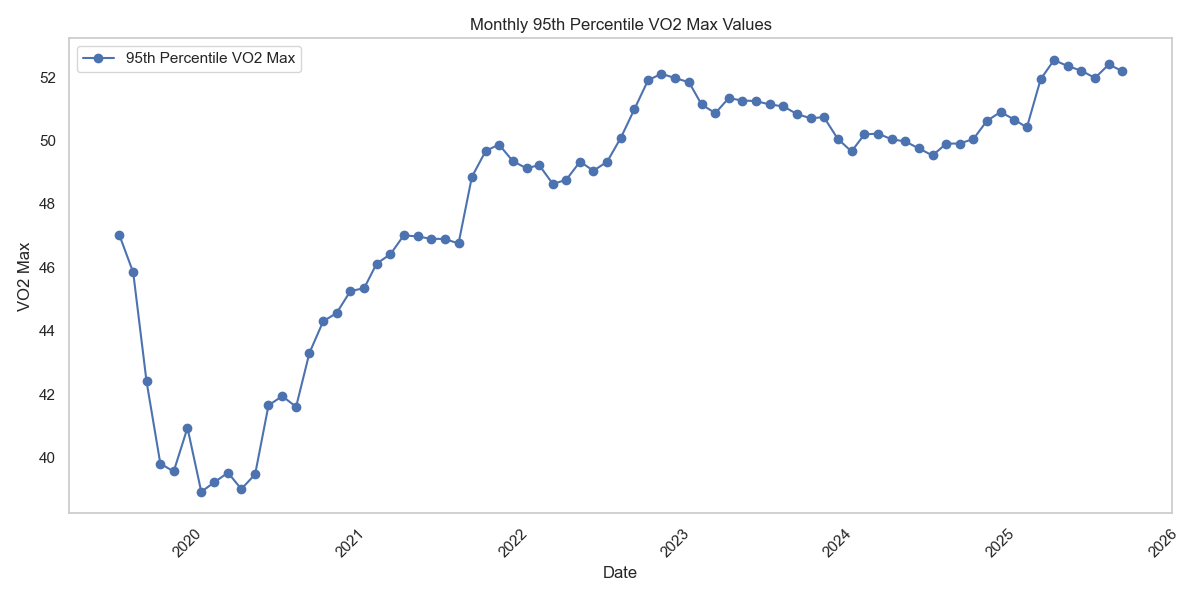
- Improve Vo2Max ❌
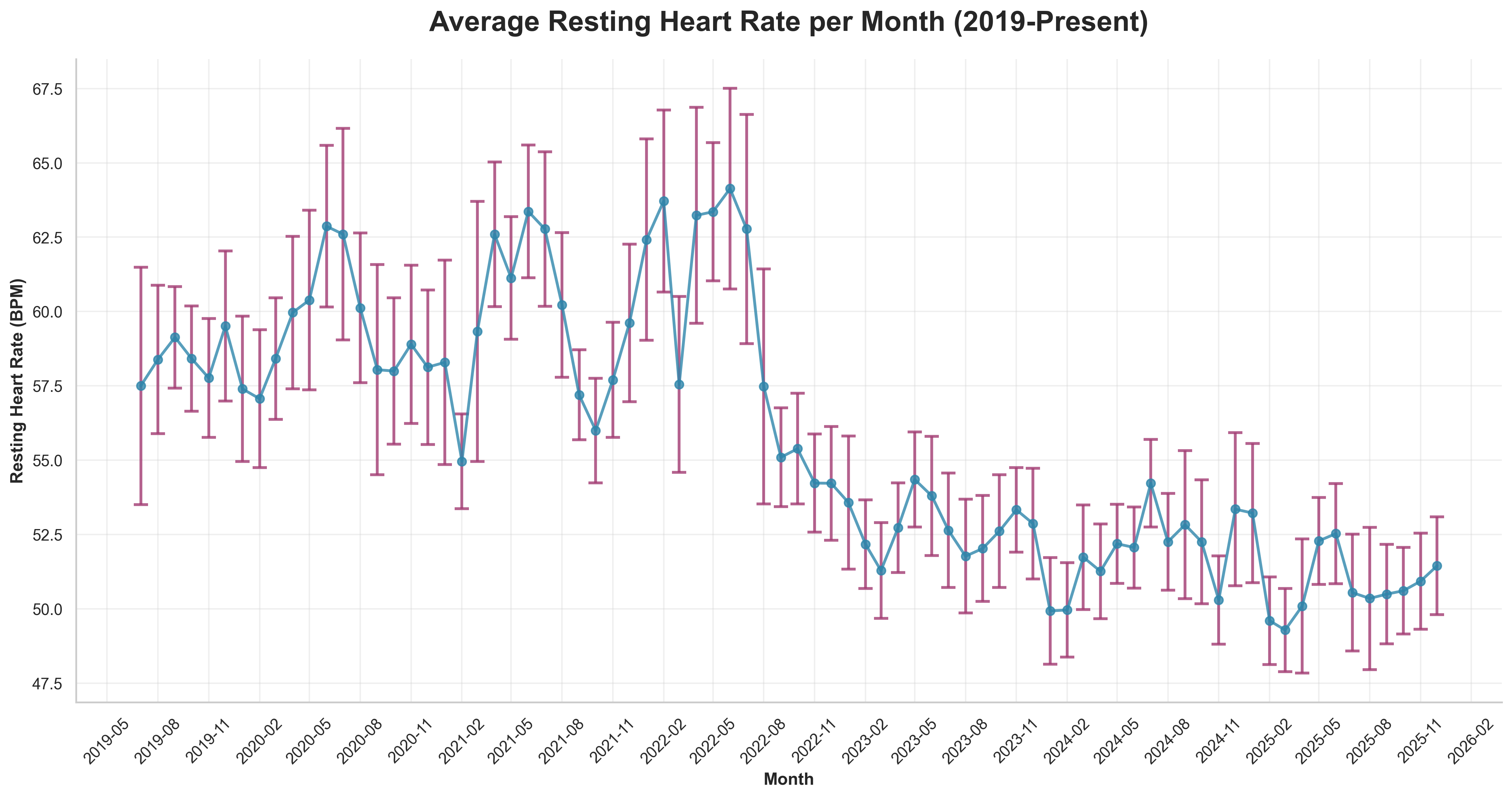
- Decrease RHR ❌
Analysis
I look at intensity minutes as a way to make sure I’m getting enough fitness, regardless if I’m running or at the gym or kayaking. My goal is 800 minutes per week 80% of the weeks, which is significantly higher than the commonly recommended 150 minutes per week. The reason I’ve chosen to say “80% of the weeks” is because there are some weeks when I need to travel for work, and it is harder to reach this target.
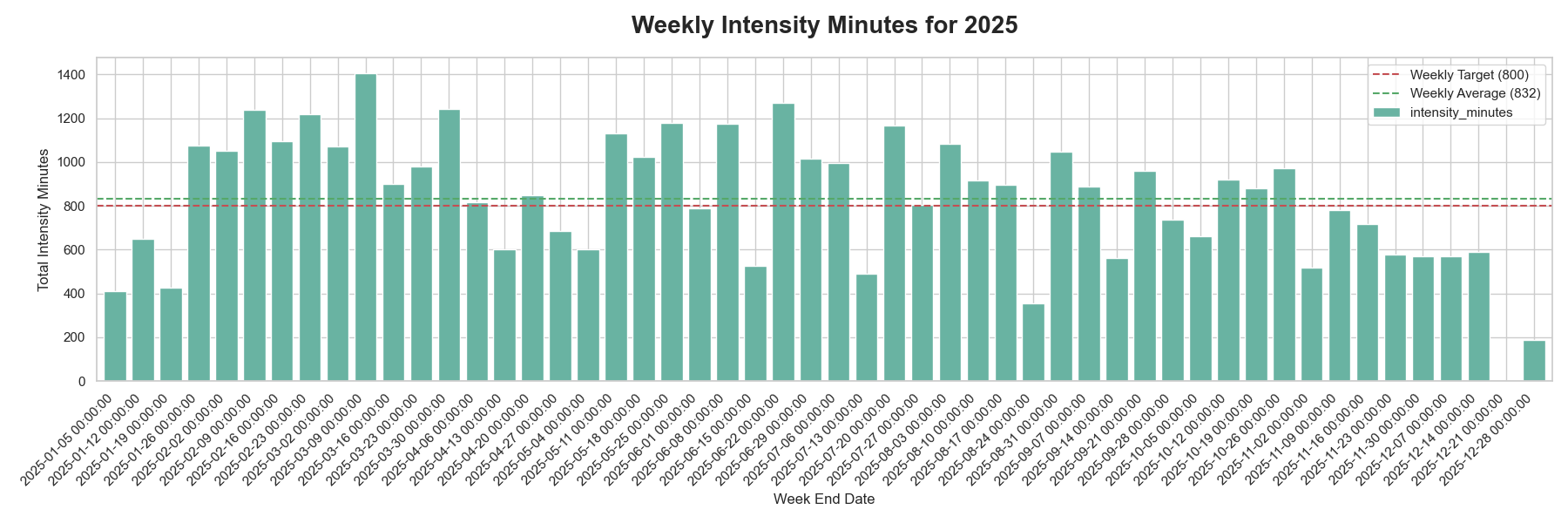
My average intensity minutes for the quarter was was 610 minutes per week, which unfortunately is the only quarter in 2025 where I didn’t reach my 800 minute goal.
In addition to load we can have a look at Resting Heart Rate, as that is often related to both load and sufficient recovery.
And let’s look at Vo2Max, which stayed roughly the same this quarter, but will crash when I start running again. I believe my high was 53 for a few weeks, but falling to 51 eventually as I couldn’t make time (or have the discipline?) for my regular levels of fitness.
Experiments
- In week 49-50 I managed to break my ankle, so wasn’t able to run much in December. However, I’ve been meaning to pick up swimming, and while I’m not getting the same cardio effect as I got from running, at least I’m still exercising. I keep reminding myself that this isn’t about good/bad, but better/worse. Plus, I’m learning a new skill, which is probably a good thing!
Improve Sleep
Goals
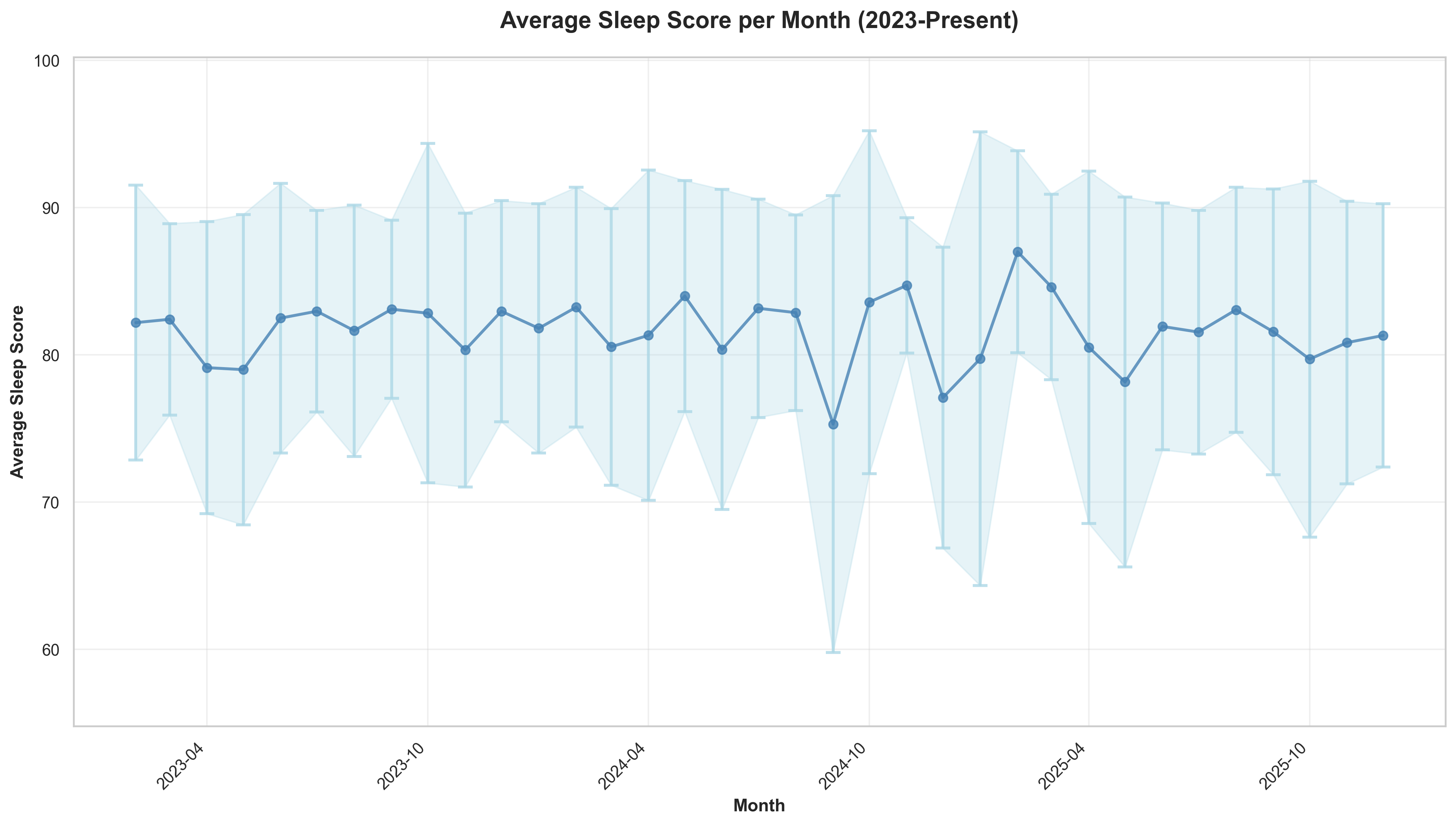
- Keep average sleep score about 80 ✅
Analysis
Let’s have a look at my sleep scores since buying my Garmin:
And then when comparing each quarter this year we can see some trends with each day of the week.
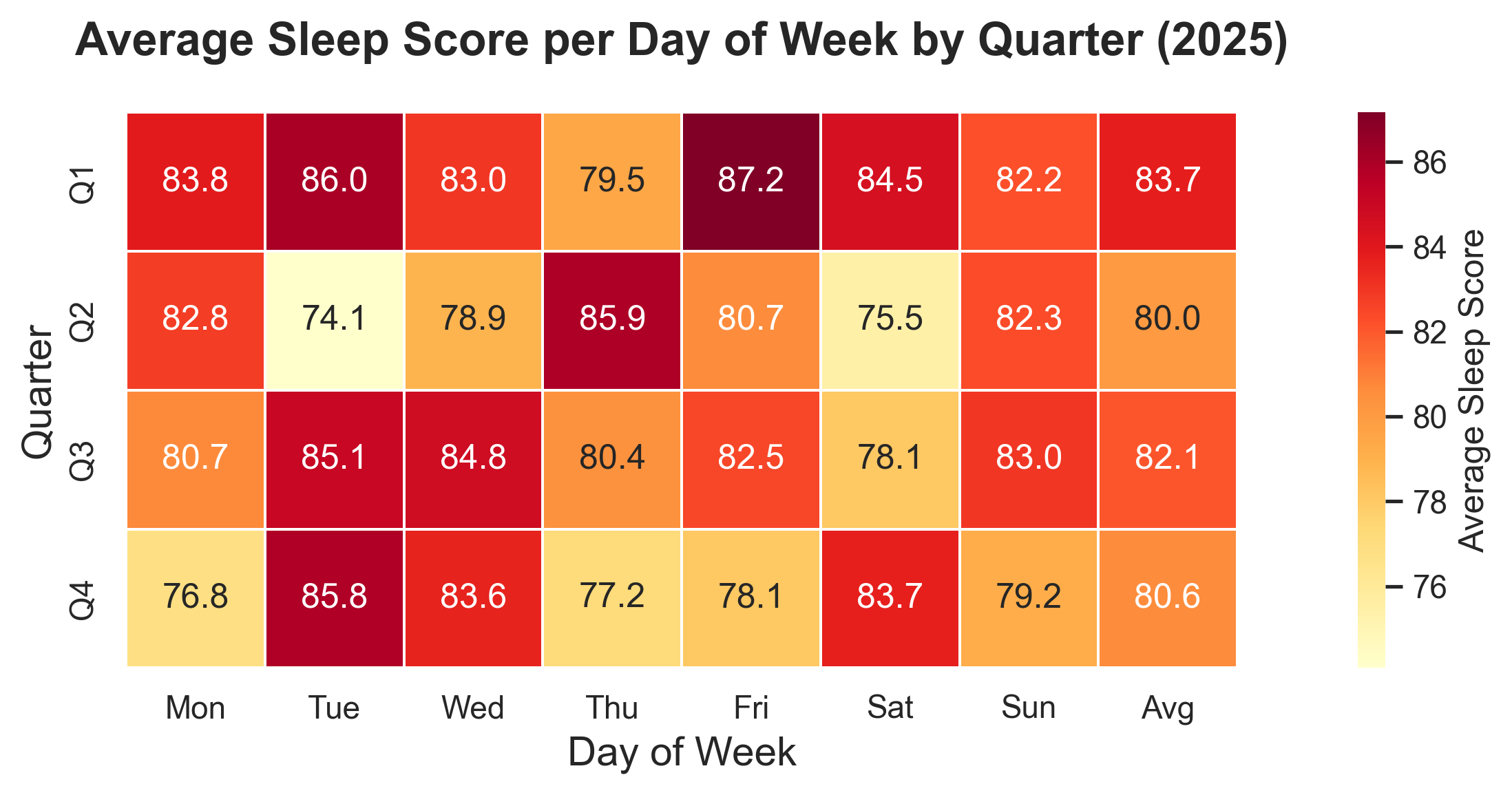
Q4 was absolutely a challenging quarter for me from a sleep perspective, in particular in October and November. December was more hit and miss, where some nights I would get high 80s, and other nights get 70s. One bad habit that I started to develop was cooking less meal prep, which resulted in both eating out more, and eating later. I think, for me, it really is best to eat a lightish lower carb meal between 4:00pm and 5:00pm.
Experiments
I conducted a few sleep-related experiments this quarter, including:
- I now sleep with an eye mask and ear plugs every night. The custom made ear plugs seem to be working well.
- Continue to try and adhere to a 3-2-1 routine (no food for 3 hours before bed, start ‘wind down’ 2 hours before bed, and no screens 1 hour before bed). Garmin’s correlation picked this habit up immediately and marked it as having a positive impact.
Overall mostly a success, but having to work hard to keep up good habits.
Decrease Stress
Goals
- Decrease stress ❌
Analysis
Let’s have a look at stress per quarter grouped by day of the week:
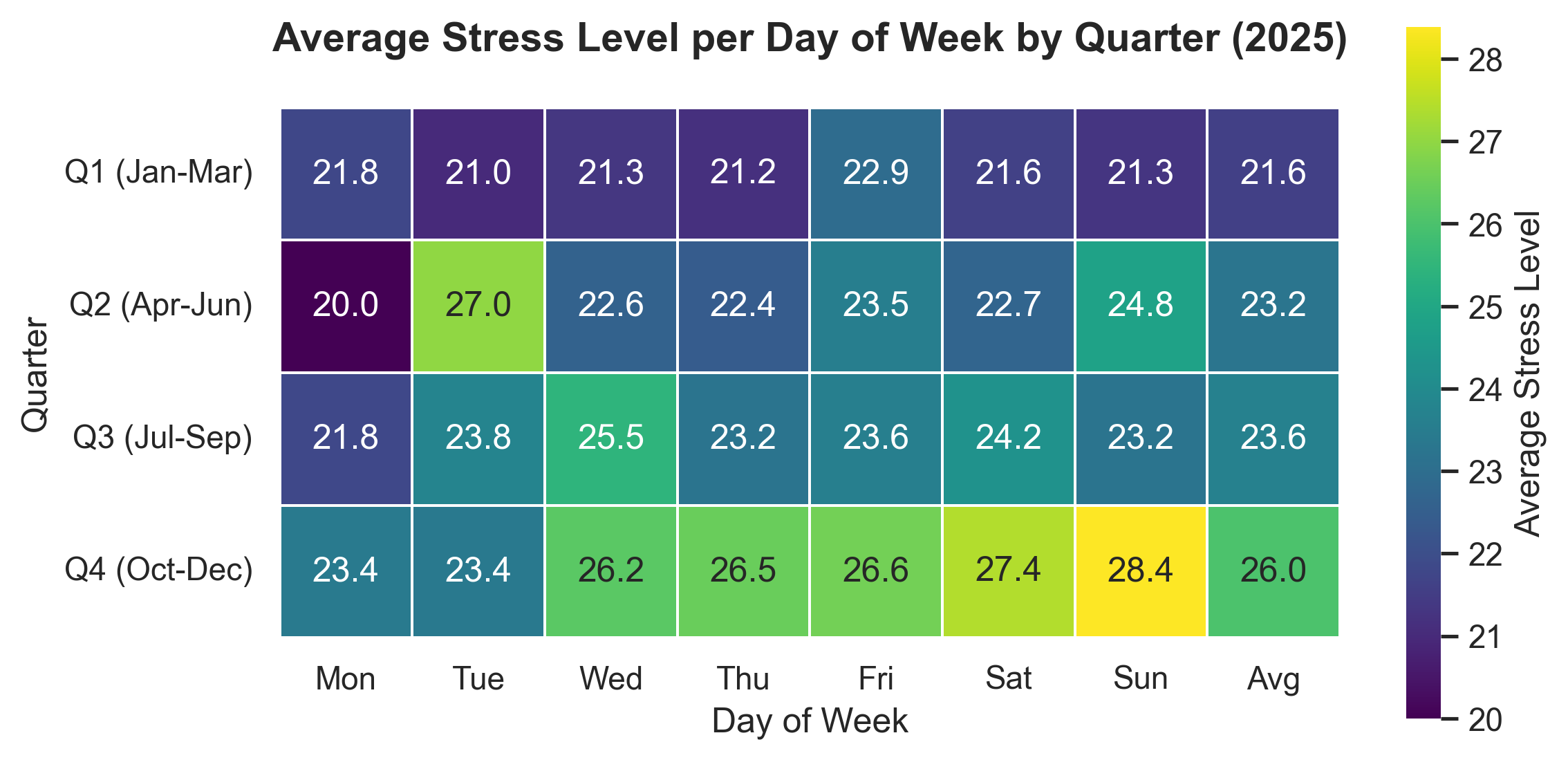
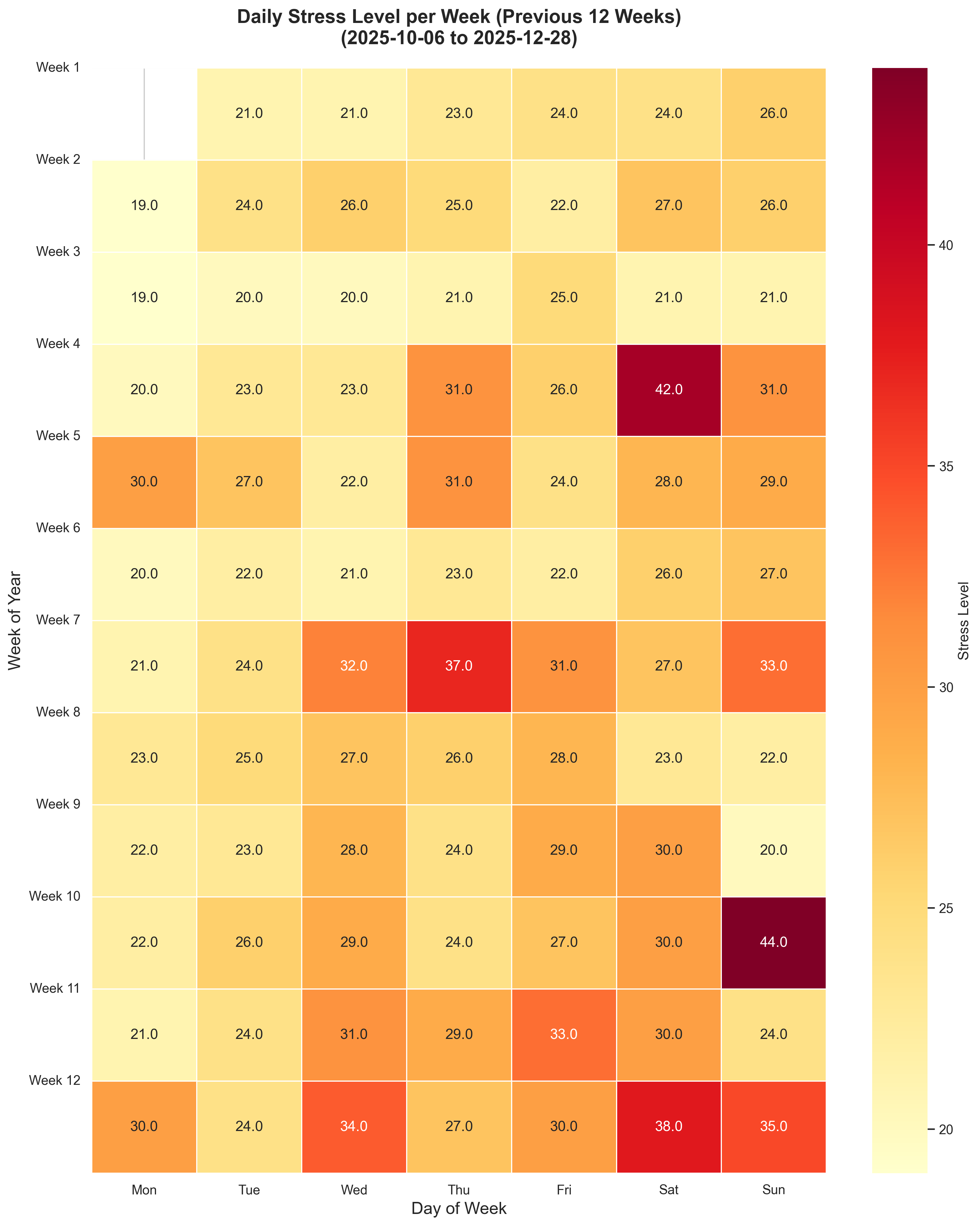
Garmin’s method of displaying stress has a delineation between low (blue, <25), medium (orange, >25), or high (red). Usually I’m all blue, and now I’m all orange - especially in December. Much of this is work related, directly and indirectly, but I’m not certain the breakdown.
Experiments
- No stress-related experiments for the quarter.
Improve Biomarkers
Goals
- Decrease IGF-1 ❌
- Decrease MCV ❌
- Decrease RDW ✅
- Increase Albumin ✅
- Decrease hsCRP ✅
Analysis
Comparing my Q4 biomarkers to Q3, here’s how things changed:
| Biomarker | July 2025 (Q3) | Oct 2025 | Jan 2026 | Trend | Status |
|---|---|---|---|---|---|
| IGF-1 | 30.9 nmol/L | 35 nmol/L | - | Increased | Above range |
| MCV | 95 fL | 94 fL | 101 fL | Now HIGH | Above range |
| RDW | 12.8% | 12.6% | 12.5% | Decreased | In range |
| Albumin | 40 g/L | 43 g/L | 45 g/L | Increased | In range |
| hsCRP | 0.7 mg/L | 0.2 mg/L | <4.0 mg/L | Mixed | In range |
Key Findings:
Concerns (❌):
- IGF-1 increased to 35 nmol/L (above reference 7.6-28.5). This is concerning for longevity as lower IGF-1 is associated with increased lifespan. Despite removing pea protein from my Nutty Pudding, IGF-1 still increased. The upper note suggests keeping “well below 45-50 nmol/L” so I’m still under that threshold, but trending wrong direction.
- MCV jumped to 101 fL in January (above reference 79-99). This is a new concern - elevated MCV can indicate B12 or folate deficiency (though B12 came back at 435 pmol/L), liver issues, or hypothyroidism. The increase from 94 → 101 fL warrants investigation.
Wins (✅):
- Albumin increased to 43 → 45 g/L. Higher albumin is associated with better longevity and overall health.
- RDW decreased to 12.6 → 12.5%. Lower RDW correlates with reduced mortality risk.
Experiments
I did have a fair amount of experimentation here, including:
- IGF-1: Removed pea protein from my Nutty Pudding recipe to reduce IGF-1. Unfortunately, IGF-1 still increased from 30.9 → 35 nmol/L.
- Vitamin D: Increased from 1,000 IU to 4,000 IU, which successfully brought levels from deficient (36 nmol/L) to optimal (107 nmol/L).
- B12: Continued B12 methylcobalamin and L-Methylfolate combination. B12 improved from 271 → 435 pmol/L.
- Iron: Continued taking iron 3x per week, though ferritin remains below target.
Because of subscribing to Cronometer I’m able to get more reports, such as my Nutrient Balances and Nutrient Targets, which have encouraged me to tweak the food I eat.
Supplement Stack
Some principles that I tried to follow:
- Avoid bill burden; prefer food over pills.
- Wait until a supplement is on the ITP supported interventions page, or has significant evidence behind it
- Have a biomarker in mind that a certain supplement will change
And here’s what was in my stack for Q4:
| Morning | Evening | Ad Hoc |
|---|---|---|
| Vitamin D (4000 IU) | Glycine (10g) | Iron (20mg) |
| Vitamin K2 mk7 (100mcg) | NAC (1g) | Vitamin C (500mg) |
| B12 Methyl (1000 mcg) | Tart Cherry | Fish Oil (6g) |
| L-Methylfolate (1000 mcg) | Melatonin (300mcg) | B5 P-5-P (50mg) |
| B6 (25mg) | ||
| Zinc (15mg) | ||
| Hyaluronic Acid (200mg) | ||
| Iodine (150mcg) | ||
| Creatine (5g - in smoothie) | ||
| TMG (1.5g - in smoothie) | ||
| Boron (1mg - in smoothie) | ||
| Taurine (3g - in smoothie) | ||
| Astaxanthin (7mg) | ||
Here are the changes that I made this quarter:
- Removed Niacin. I’ve long suspected that this might impact me sleep, where I’ll get startled at night and then can’t get back to sleep. I can appreciate that in theory my NAD levels might decrease, but I’ll prioritise sleep right now, especially if I can’t get the amount of exercise that I want.
- Removed Lysine. Cronometer was showing that I was getting enough.
- Removed B12 liposomal. Previous blood tests showed my b12 levels were where they needed to be.
- Removed Calcium. Eating more yogurt now, so feels safe to remove.
- Removed Fish Oil. Will continue consuming sardines periodically.
I may add some of these back in at a later date.
Focus For Next Quarter
Q4 was challenging - injury, illness, and work stress all took their toll. My fitness metrics regressed, sleep became more variable, and stress increased. However, I maintained my philosophy of making “better decisions, not worse decisions” and continued to track and optimise where possible.
For Q1 2026, my focus areas remain consistent:
- Improve fitness - Now that my ankle is healing, gradually rebuild intensity minutes. Swimming will remain part of my routine while I ease back into running. Desperately need to put on muscle.
- Sleep better - Re-commit to early, light dinners and the 3-2-1 wind-down routine that was slipping late in Q4.
- Reduce stress - Being injured is stressful; I need to be mindful of this and prioritize recovery. Oct-Dec was terrible from a stress perspective, and January isn’t looking much better.
- Improve biomarkers - Investigate the elevated MCV (101 fL) and continue working on IGF-1 reduction.
Wish me luck!